Oil Management For Business Profitability
 Profit is the only motive of any commercial organization, whether it be a Public Limited Company, a Partnership Company, or a Proprietorship Company. Profit is the result of producing an item or offering any service at the lowest cost and realizing the best sales price, as the market decides the usual price and is not in the hands of the company. Profit is the function of demand and supply. If a company has to exist, then it has to follow the market and only focus on reducing costs.
Only the following three resources are available to the company to reduce the cost.
- Capital
- Workforce
- Plant and Machinery
Thus, the company is left with only three options to control the cost.
- Reduce the cost of capital – Typically, it refers to the interest on borrowed money or the loss of interest by using personal funds.
- Reduce the cost by compromising on the quality.
- Utilize resources at the optimal level for the highest level of efficiency.
We will ignore the first two options, i.e., Capital and Compromising the Quality. Both these options will never last long and sometimes will lead to the closure of the company, sooner or later. We will ignore these two aspects since it is not the focus of this article.
The only third option, i.e., the company must focus on the optimization of Investment in Manpower and Plant & Machinery. We will discuss in detail how to reduce the cost of investments in Manpower and Plant and Machinery. We will discuss the involvement of Management at a macro level.
Investment in Manpower – Engaging the person means sharing the responsibility and, therefore, sharing the authority to make decisions. Thus, in Business, engaging any person to share the responsibility and authority to make a decision is a Risk. The higher the responsibility, the higher the risk. Therefore, it is The Most critical to select and engage the most capable person for High-er Responsibility. As such, it applies to all workforce engagement since at all levels the responsibility and decision-making authority is shared to some extent.
Management needs to constantly monitor and evaluate the outcome of threats and opportunities arising from the decisions taken by these engaged persons. Thus, the authority of decision-making of an engaged person depends upon the confidence level of Management in the involved person. This is why engaging a skilled and experienced person is the most crucial step in Management.
In most of the Technical matters, Management has no choice but to depend upon the decision taken by the Engaged person involved in technical issues. Since the Skilled and Experienced Manpower in technical matters is always in short supply. The company has to compromise with the best available Manpower. Once a person is engaged, it is up to the Management’s discretion to what level his suggestions, recommendations, and advice are to be accepted and implemented. Here, the confidence level of the Management plays an important role.
This limitation is always there. Furthermore, it is also true that not all technical personnel are experts in all the latest technologies. They can manage the show, but beyond a certain level, they cannot make the best decision. This may result in missing an opportunity to reduce manufacturing costs despite investing in the latest technologies. Here, the Management can come forward and help him get trained on the technology adopted by the company. Indian Management is lagging in this field. They miss the bus in reducing costs by spending marginally on training their Technical Personnel.
Assuming that the company has engaged the best available skilled and experienced technical workforce, there is still scope to improve their output by Providing Training to them. Providing Training to recruits or refreshing Training for old wood will always help. Training can be provided by seniors in the organization, or by inviting experts from outside, or sponsoring them in attending such professional training programs conducted by experts. The keyword is TRAINING and EXPOSURES.
Very few companies are alert to this & are investing in training their Manpower. Most of the time, the company neglects this crucial area due to a lack of budget, a Lack of Time, Pressure on Production Schedules, and a lack of willingness to invite & pay outside expert agencies. They do not realize that the advantage of spending marginally on Manpower Training will increase the productivity of both Manpower and machines.
Investment in Latest Plant and Machinery
Production cost is directly related to the Plant and Machinery Engaged. There is constant improvement in machine performance worldwide. Speed and improvement in the quality of the output are the aims of any company to reduce costs. Depending on the capital available, all companies try to adopt the latest technologies. However, any new machine or technology needs expertise, skilled, and experienced Manpower to use it at an optimum level. After initial Training to technical persons by the supplier of the Machine, day-to-day operation and Maintenance is the responsibility of the Technical persons engaged by the company. Here is the most significant risk. The Machine has to work at an optimum level – neither under-use nor over-use or misuse. Cost of Production is directly related to the performance of the Machine. Over time, Machine operators and engineers responsible for the Machine learn how to improve its performance. However, this will be achieved through a trial-and-error method if there is no Proper Training. But this is again at a cost. This is quite avoidable if Management spends on Training.
Due to budget constraints, Management often avoids the suggestions, recommendations, and advice of the Responsible Technical person for marginal expenses for improvement in the performance of the Machine or even to maintain & service it properly. By not spending the Money on their suggestions for improving the machine performance, the company is indirectly losing a lot more on opportunities to save Money. It is therefore necessary for Management to consider his advice seriously.
To maximize profit by reducing costs, Management must ensure that it avoids the risk of under-use, over-use, or misuse of the Machine.
Let us examine the key factors that help minimize this risk & reduce the Costs.
Factors Affecting the Performance of the Machine
Includes
- Limited knowledge of the Machine Operation and Maintenance.
- Limited budgets in the Maintenance & operation of the Machine.
Let us go into more detail about each of these two factors.
Limited knowledge of Machine Operation and Maintenance: Actual hands-on experience & knowledge of operating the Machine, as well as a theoretical understanding of machine operation, are two distinct aspects.
There is a chance that the senior Technical person, like a Technical Director or Technical General Manager, has any practical hands-on experience of operating the Machine. It is equally valid that there is no need for them, even though not all shop floor engineers have any hands-on experience in operating the Machine.
Similarly, a semi-skilled machine operator will not have theoretical knowledge of the machine operation. He is also not expected to know it.
The Machine will perform at its optimum level only when a combination of these two technical persons works together, complementing each other’s skills & knowledge. The machine operator needs to follow the instructions of the Engineer, and the Engineer must listen to and understand the comments and suggestions made by the Machine operator.
Here, interpersonal relations play a vital role. Management needs to play an essential role in maintaining these relations healthy and cordial.
Establishment of a healthy relationship will be possible only when both of them have a common understanding of the machine operation and Maintenance. For this, both of them need professional Training. When the parallax between their knowledge of the machine performance and Maintenance is reduced, there will be better coordination and higher chances of producing Quality material at the lowest cost. This is only possible through common Training programs and knowledge sharing.
Limited budgets in the Maintenance & operation of the Machine. The performance of any machine depends upon Maintenance and repairs. Not only the performance of the Machine but also the performance of the machine operator, Production, and Servicing / Maintenance Engineers rely on the performance of the Machine. When the Machine is not maintained correctly, frequent breakdowns will reduce Production and create stress on machine operators, production, and maintenance engineers. Their efficiencies will be reduced.
Thus, the overall cost of Production is inversely proportional to the Price of the Maintenance budget. Unless Management allocates sufficient Maintenance Budgets, the direct or indirect expenses incurred in maintaining the production level will exceed the savings from the reduced maintenance budget. Therefore, it is necessary for the Management to carefully decide the Maintenance Budgets and allow the responsible Technical person to spend Money for Maintenance. Cutting corners will be more expensive.
What is a Maintenance Budget?
For the operation of the Machine, three things are required. Money is spent on these three factors:
- Manpower Machine operator, including supervisors, service and maintenance engineers.
- Power to operate Machine – Electrical / Mechanical / Fluid Power.
- Consumables for Maintenance of Machine – Lubricants, Spare parts, and enough time for shutdown of the Machine for proper Maintenance.
How to get the best out of all three of these factors?
A. Machine Operator, including Supervisors, Service and Maintenance Engineers –
The solution is in Training and incentives
-
Incentives in the form of recognition by Public Appreciation, Awards, Monetary benefits, and Gifts for good performance or improvement in performance. Allow family members to visit the factory once a year as a common celebration/ festival. This will establish the sense of ownership of the Machine by them.
-
There is no alternative to Training. Ownership of the Machine is developed when a person is trained to operate. Introduce and expose them to new ideas and techniques for improving the Machine’s performance and reducing operational costs. Listen, and if feasible, accept their suggestions and encourage them to think. If not expensive, allow them to experiment with their ideas using the Machine for improvement. Most important is not to compromise with the cost of machine Maintenance & repairs.
B. Power – Electrical / Mechanical / Fluid Power –
-
Electrical Power: Unless it is a captive power plant, a company cannot do anything about the cost of Electrical Power. Assuming we are discussing small and medium-sized organizations that obtain Power from a power-generating company, we overlook the cost of Power in our analysis, except for addressing power wastage.
-
Mechanical Power: There is not much to discuss regarding savings in mechanical power transmission, such as gearboxes, Pulleys, Belts, and Couplings, except for regular maintenance costs.
-
Fluid Power: This is an interesting area of cost saving. In fluid Power Transmission, Power is transmitted through fluids like Air & Oil. Since Power Transmission is through Fluid, it is highly flexible and therefore very much preferred by Machine Designers. However, both are expensive and can be problematic if not handled carefully. Here are the maximum chances of wastage as well as savings…. There is a significant scope for reducing costs and achieving savings.
-
80 to 85% of the Operational & Maintenance costs can be saved from proper Management of Fluid Power Transmission. Air / Oil Management is the key word for it.
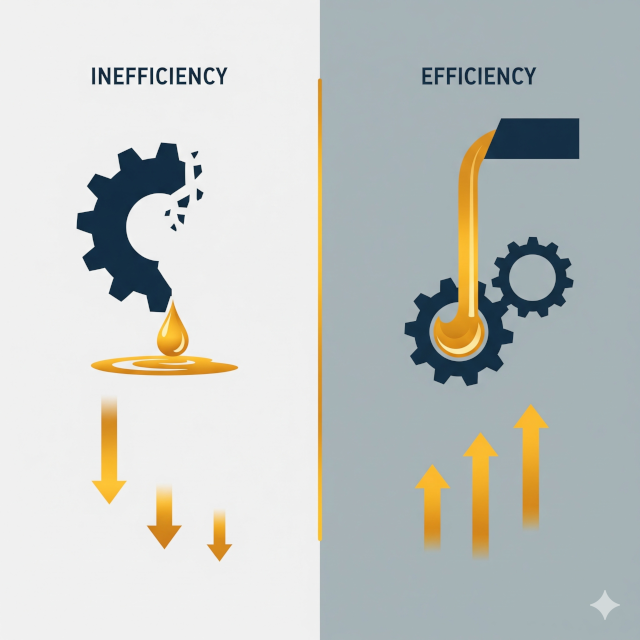 Oil Management & Business Profitability
Any Management aims to reduce the cost. There is a tremendous scope for savings in Fluid Power Transmission, mainly by controlling and reducing the consumption of fluids such as Air, Lubricants, and Hydraulic Oil.
Fluid Power Transmission is a very specialised method of power Transmission and, if used correctly, will save a substantial amount of Money. But not all operators or engineers need to be experts on it. It is therefore most essential to impart proper Training on OIL MANAGEMENT to operators, Supervisors, and Service and Maintenance Engineers by inviting Experts from outside.
A lot more savings are possible from properly handling Fluid Power Transmission. Oil or Compressed Air are the primary Fluid Power Sources, and due to ignorance, they are wasted the most. Managing the Hydraulic Oil and Hydraulic System needs special Training. There is no choice but to invite an outside expert on this subject. Savings will far exceed the cost of Training.
Focusing on a few of the following Areas will help Management save Money. Some fundamentals are:
- Leaking Air is the main reason for power loss. Please stop it.
- Hydraulic & Lub Oil Management
Hydraulic Oil Wastage and mismanagement are the sources of most wasted and costliest items, i.e., hydraulic Oil. It is due to a lack of knowledge and Training. There are many areas in Oil Management where significant scope for savings can be achieved with just a little more knowledge and Training.
Hydraulic Oil is wasted due to:
- Lack of Knowledge of Oil itself. Consumption of Lub and Hydraulic Oil is a significant expense in machine maintenance and Repairs. Understanding the Oil will help in reducing this consumption.
- Lack of Knowledge or minimal knowledge of the functioning of the Hydraulic System.
- Lack of Monitoring and controlling the factors affecting the Oil and Hydraulic System, and costly components like Pumps and Valves.
A few critical factors affecting Hydraulic Oil & System are Micron Size Particles, Oil & water mixing, System overheating and leakages, Mishandling, and faulty method of storage of Oil & many more. Oil gets highly contaminated just by mishandling it, and still the handlers are not aware of it. Just knowing how to handle Oil itself will save the Oil. These factors not only damage the Oil itself but also damage the expensive components like Pumps and Valves, directly affecting the performance of the Machine.
Once Operators and Engineers are trained to monitor and control these factors, it will not only reduce the frequency of machine breakdowns but also improve the performance of the machines and save the Oil & components from getting damaged by contamination. It will have a tremendous impact on cost reduction.
Most important is the savings in the premature replacement of expensive Oil. It is observed that most of the time, instead of removing the contamination from Oil and cleaning it, healthy Oil is discarded just due to a lack of knowledge as to how to clean the Oil. But it costs heavily to the organization. Better to engage the expert external agency to do it professionally. It will be at a fraction of the cost of doing it in-house.
Trying to do it in-house is expensive, as it requires a specialized filtration unit, an expertly trained workforce to operate and maintain it, and additional costs for consumables such as filters, as well as maintenance & repair expenses. Additionally, it is not the primary focus of the Production unit. Therefore, it is advisable to take the help of professional external experts at a fraction of the cost of all these expenses.
Almost 80 to 85% of the cost spent on Hydraulic systems & New Oil Purchase can be easily saved with little expense on Training and taking the help of professional Experts. Therefore, Training by Experts and professionals is the only solution.
Here, MANAGEMENT needs to understand the OIL Management and increase the profitability.
A lot more can be written and discussed on the subject, but it is not within the scope of the article.
