
The Grease Test That Predicts Failure Before It Happens
FAG FE8 test predicts grease failure before it happens: extreme bearing stress testing prevents costly industrial downtime.
How the FAG FE8 test puts grease through conditions tougher than almost anything it will face in the real world — and why that matters for any machine that has to keep running.
Every spinning machine — from the wind turbines that power the grid to the gearboxes inside a steel mill or the rollers in a paper plant — relies on the same small, unsung component: the bearing. Bearings let things rotate smoothly. And what keeps a bearing from grinding itself to dust is a thin coating of grease.
Most of the time, this grease does its job invisibly. But in heavy industry, bearings are asked to do brutal work: huge loads, slow turning speeds, high temperatures, and years of continuous operation. When grease fails under those conditions, machines fail — and a single bearing failure in a wind turbine or a steel mill can cost tens of thousands of dollars and shut down production for days. So how do engineers know, before they pump a grease into an expensive machine, whether it can actually handle the punishment? They use a test called the FAG FE8.
A Stress Test Designed to Hurt
Think of the FE8 the way doctors use a treadmill stress test. You’re not interested in how well someone walks at normal pace — you want to know how their heart copes when pushed to its limits. The FE8 does the same thing for grease.
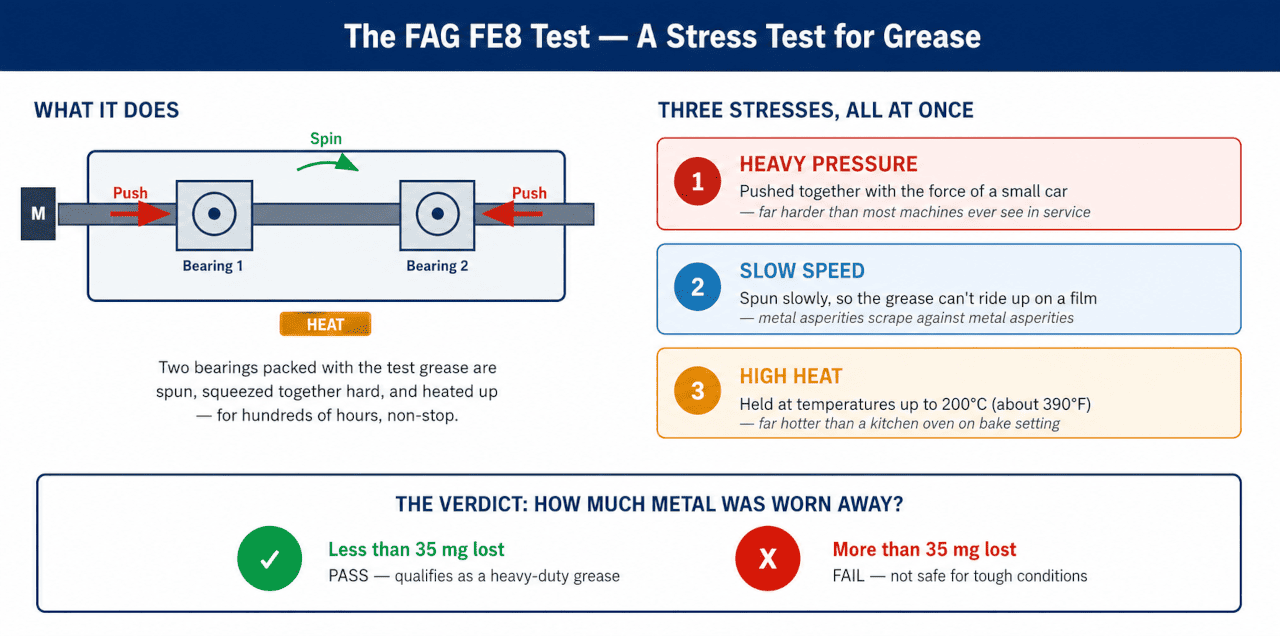
Inside the test machine, two bearings are mounted facing each other on a shaft. A grease sample is packed in, and then three things happen at the same time: the bearings are squeezed against each other with enormous force, the shaft is spun slowly, and the whole assembly is heated to temperatures hotter than a kitchen oven. The test runs for hundreds of hours straight.
That combination — heavy pressure, slow speed, high heat — is deliberately worse than what most real machines experience. The logic is simple: if a grease survives this, it will almost certainly survive the real world. If it fails here, it would have failed in service eventually, and the test caught it before it cost anyone a bearing.
Measured in Milligrams
After the test ends, engineers take the bearings apart and do something almost laughably low-tech: they weigh them. The bearings were weighed before the test, and now they’re weighed again. The difference — measured in milligrams — is how much metal the grease failed to protect.
Under the international rule book (a German standard called DIN 51819), a grease that loses less than 35 milligrams of metal during the test earns the label of a heavy-duty grease. Anything more, and it’s considered unsuitable for tough conditions. That 35-milligram number isn’t arbitrary — it was calibrated decades ago against real bearings from real machines, and the threshold has held up because it matches what happens in the field.
The 35-milligram figure is the headline, but a full FE8 report documents much more: how the cage wore, what the raceway surfaces looked like under inspection, how the grease itself changed during the test, and whether the rig had to be shut down early because temperature or vibration ran away. A grease that just barely passes on wear but caused premature shutdowns is not the same as one that ran cleanly to the end.
Why Simpler Tests Aren’t Enough
The grease industry has plenty of other tests. The dropping point test heats a grease until it starts to drip; the four-ball test rubs four steel balls together until they weld; the cone penetration test measures how stiff or soft a grease is. These tests are fast, cheap, and useful — but here’s the catch most data sheets don’t mention: they were never designed to predict how a grease will perform inside a real machine.
ASTM, the body that writes the standards for these tests, says so directly. The official standard for the dropping point states the result has “only limited significance with respect to service performance.” Major grease manufacturers describe it the same way — a quality-control tool, not a performance predictor. The four-ball test has its own issues: it uses point contact between balls, not the rolling motion of a real bearing, and published research has shown that small changes in test settings can swing a grease’s apparent performance by 50% without changing the grease at all.
These tests are useful for confirming that a grease has been made consistently, batch after batch. They are not, and were never meant to be, evidence that a grease can survive in a working bearing. The FE8 is. It puts the grease inside the exact thing it has to protect, under conditions worse than reality, and asks the only question that matters: did the bearing survive?
This is why every major bearing manufacturer, every serious wind turbine company, every railway, every steel plant, and every automotive transmission maker insists on FE8 results before approving a grease for critical use. The simpler numbers tell you the grease is consistent. The FE8 number tells you whether it works.
What This Means in Practice
- If you maintain industrial equipment, ask grease suppliers for their full FE8 report — not just whether it ‘passes,’ but at what load, what temperature, and how much wear was measured.
- If you specify lubricants for a plant, treat the FE8 number as one of the most reliable predictors of how a grease will hold up in heavy service. Other tests are useful screens, but the FE8 is the one cited when something goes wrong.
- If you’re just curious, remember that the reason your washing machine, your car, and the local power grid keep working has a great deal to do with whether the grease inside their bearings has passed tests like the FE8.
- In an era where unplanned downtime is one of the most expensive things that can happen to an industrial operation, the unglamorous, decades-old FE8 test remains one of the most powerful tools we have for catching problems before they become disasters.
Keep reading