
The Two Coolant Families Every Data Centre Operator Is Betting On - And What It Means For Your Fluid Skills
Master data centre coolant chemistry: water-glycol & dielectric fluids to prevent downtime, maximize AI compute.
For decades, data centre operators treated cooling as a mechanical engineering problem. Today, as we frequently advise our partners at Reliability Engine, surviving the AI infrastructure boom requires a completely different discipline: chemical engineering.
Data centres are moving decisively from air conditioning to liquid cooling. The global data centre cooling market is projected to hit $40 to $45 billion by 2030, with liquid cooling alone accounting for $15 to $20 billion.
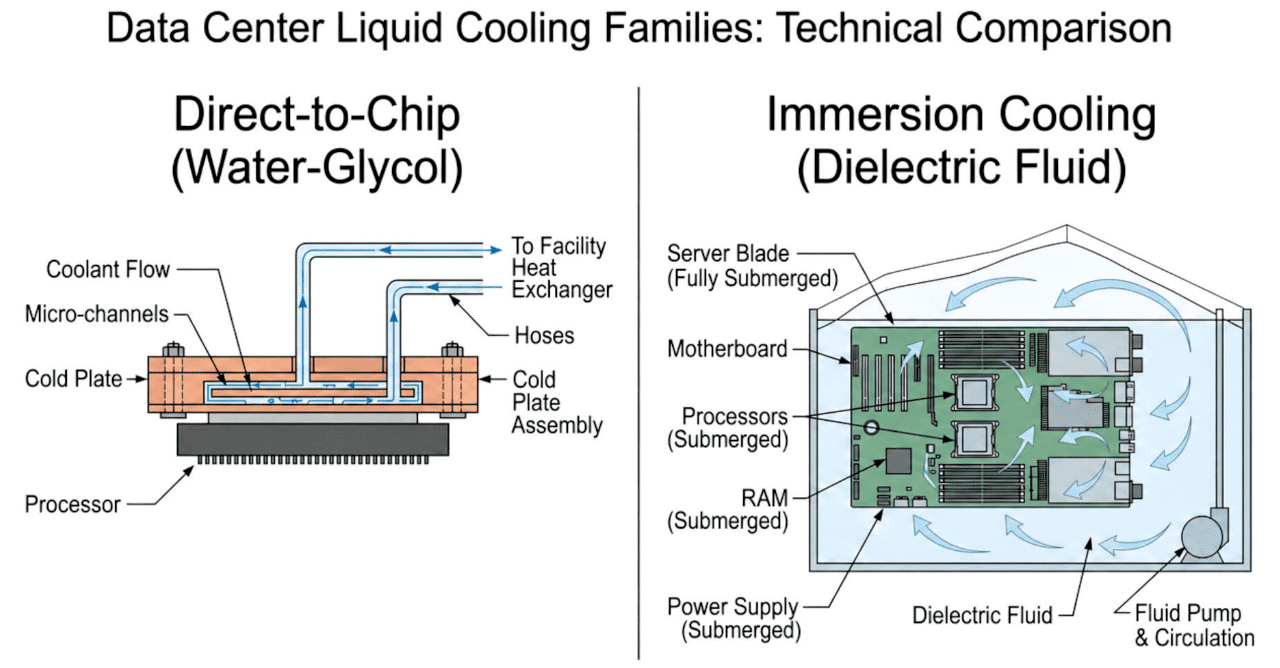
That growth rests on two main fluid families: water-glycol mixtures for direct-to-chip cooling, and dielectric fluids for immersion cooling. Both draw heavily on the same fluid-conditioning skills you already use, but the financial stakes for getting them right have never been higher.
1. Direct-to-Chip: Why Water Quality is Your Biggest Liability
Direct-to-chip is the most widely adopted liquid cooling method in modern data centres. A coolant loop circulates fluid through micro-channel cold plates mounted directly on processors, memory, and other high-wattage components. The fluid never contacts the electronics - it pulls heat through a metal plate and rejects it to a facility water loop or outdoor heat exchanger.
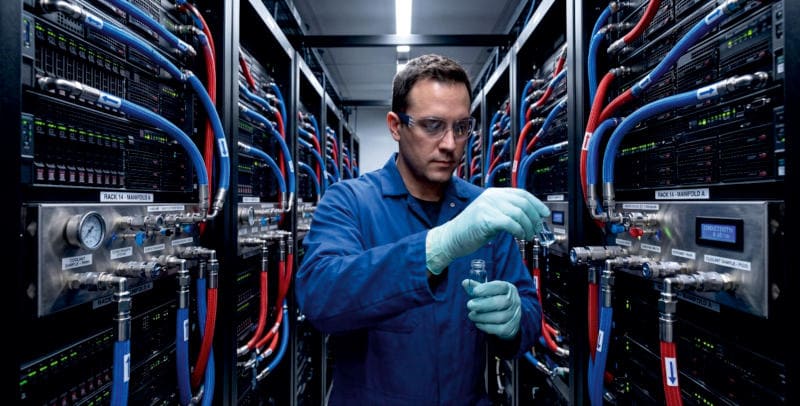
The standard coolant is PG25 - a 25% propylene glycol and 75% water blend. Anyone who has maintained a glycol loop in an HVAC system, a food plant, or a low-temperature chiller will recognise it. The glycol provides freeze protection down to around -10 degrees Celsius and a baseline of corrosion inhibition. Leading chemical companies now sell ready-made PG25 fluids designed to the Open Compute Project specification for material compatibility in cold plates.
The real action, though, is in the water.
The Chemical Mandate. Water quality is non-negotiable. Specifications call for deionised (DI) or reverse osmosis (RO) water with conductivity held below 5 to 10 µS/cm. This keeps stray current problems at bay in the event of a minor leak and, under normal operation, reduces the risk of scale formation to near zero.
Ignoring this Chemical Mandate - a foundational principle we champion at Reliability Engine - is what leads to catastrophic, multi-million dollar derating events. The most expensive mistake operators make is topping up with hard tap water. A single top-up can introduce calcium and magnesium that precipitate inside micro-channels barely wider than a human hair.
- A blocked microchannel does not throw an error code - it silently throttles processors, costing thousands per hour in lost compute. At one hyperscale facility, a single hard-water top-up event clogged cold plates across 40 racks, triggering a week-long derating that cost an estimated $2 million in lost compute capacity.
Surviving the Chemical Mandate means watching your inhibitor package. As glycol ages, it breaks down into organic acids. Without proper buffering and a biocide programme, microbial growth and fouling appear - exactly the kind of slime and clogging found in an under-maintained cooling tower.
Industry best practice is to track coolant condition alongside pressure, flow, and thermal response, so chemistry changes and deposits can be investigated before they consume cooling margin. The power densities served by these loops are extraordinary: an air-cooled rack might handle 10 to 20 kW, while a direct-to-chip rack comfortably pushes 50 to 100 kW.
2. Immersion Cooling: The Dielectric Chemical Puzzle
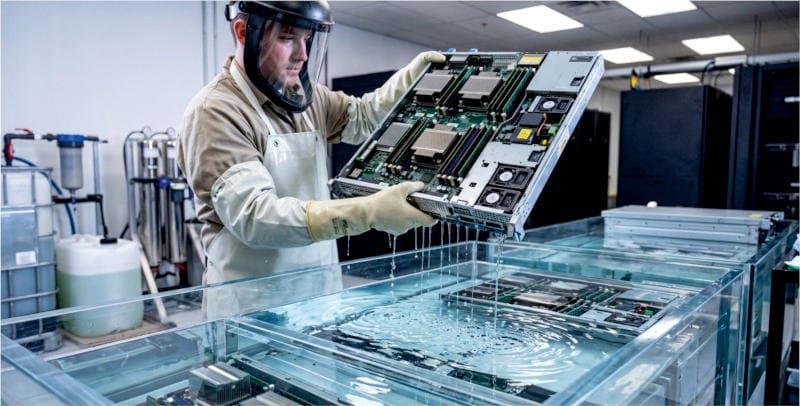
If direct-to-chip is a scalpel, immersion cooling is a full bath. Entire servers - motherboards, power supplies, everything - are submerged in a dielectric fluid that, in its uncontaminated state, does not conduct electricity.
Heat is removed either by circulating the fluid across the hardware (single-phase) or by letting it boil and condense (two-phase). Over time, moisture ingress or additive degradation can alter electrical properties, so periodic dielectric strength testing remains part of a mature programme.
The fluids fall into three main chemical families:
- Synthetic hydrocarbons: Highly refined mineral oils or synthetic base stocks. Lower cost, but higher viscosity can limit heat removal in very dense configurations.
- Fluorocarbon-based fluids: Products such as 3M’s Novec series set the performance benchmark but sit squarely in the PFAS regulatory crosshairs.
- Silicone oils and esters: Emerging alternatives with lower toxicity and better biodegradability profiles, sometimes at a slight thermal penalty.
The maintenance headache. Servers in an immersion tank are not sealed away forever. A failed DIMM or a CPU upgrade means a technician must lift the server out of the fluid.
The dielectric liquid clings tenaciously - a single hardware pull can carry out several litres of fluid, which must be captured, topped up, and accounted for. After repeated maintenance cycles, one colocation operator saw dielectric breakdown voltage drift from 40 kV to 28 kV in 18 months due to moisture and particulate ingress, forcing an unplanned fluid swap and tank clean-out that cost hundreds of thousands in downtime and new fluid.
The PFAS time bomb and a lifecycle mismatch. Many high-performance fluorocarbon immersion fluids are PFAS compounds. 3M’s decision to exit all PFAS-related manufacturing by the end of 2025 came from the regulatory mathematics reshaping the entire industry. In the EU, five regulatory authorities submitted a universal PFAS restriction proposal under REACH. In the US, the EPA is evaluating rules that could effectively ban PFAS from non-essential uses by the early 2030s.
Meanwhile, the typical infrastructure depreciation cycle in a data centre is 10 to 15 years. Fluorocarbon-based immersion fluids could face use restrictions within 3 to 5 years - a mismatch that could leave tanks filled with a stranded asset.
3. Quick Reference Comparison
| Feature | Water-Glycol Direct-to-Chip | Dielectric Immersion Cooling |
|---|---|---|
| Typical fluid | 25% PG / 75% RO water | Synthetic hydrocarbon or fluorocarbon |
| Conductivity risk | Low if maintained; upsets introduce contaminants | Very low in pure form; field contamination alters properties |
| Main maintenance | Routine water chemistry checks and inhibitor top-up | Fluid recovery, filtration, and cleaning after hardware pulls |
| Regulatory outlook | Widely accepted (local glycol disposal rules apply) | PFAS restrictions tightening fast; future uncertain |
| Service safety | Wet electronics if seals fail | PPE mandatory; spent fluid handling is regulated |
| Typical rack power | 50 to 100 kW | 100 kW and above |
4. The Economics: Fluid Health as a Profit Lever
Beyond the chemistry, a hard financial force is pushing liquid cooling forward. Moving from air to direct-to-chip typically drops a data centre’s Power Usage Effectiveness (PUE) from around 1.6 toward 1.1. Air-cooled data centres generally perform efficiently up to approximately 20 kW per rack.
By contrast, liquid-cooled configurations in comparable deployments report stable PUE values of around 1.15, even at densities of 80 to 100 kW. That shift can reduce cooling OPEX by 30 to 50% at scale.
But here is where operators fail: When you neglect fluid health - allowing scaling, viscosity drift, or friction to build - you are paying what we at Reliability Engine define as a Token Tax. Bad plumbing and degraded chemistry literally steal compute tokens per watt right out of your pocket by forcing the system to throttle processors or burn excess pump power.
Higher rack density - up to 3x more servers in the same footprint - defers or eliminates new building CAPEX. For an industrial fluids professional, this reframes the conversation: coolant is no longer a utility - it is a profit lever.
5. Why This Matters in Practice
Data centre cooling is, at its core, a thermo-fluids problem. Pumps, seal compatibility, heat exchangers, filtration skids, corrosion inhibitor depletion, fluid degradation curves - none of this is new. The critical difference is that here, fluid condition directly influences compute throughput.
In AI clusters, Reliability Engine has seen firsthand how well-maintained coolant loops help keep processors running at sustained boost clocks without throttling; neglected loops leave millions of dollars of compute capacity on the table.
Further Reading
Continue with these Reliability Engine field guides:
- The Step-by-Step Guide to Implementing Liquid Cooling
- Before You Connect a Single GPU: How to Prove a New Cooling Loop Is Ready
- Understanding Pressure Drop in Liquid Cooling
- Explore all Reliability Engine insights
References
- McKinsey & Company, “Keeping Cool in the Data Age,” September 2025.
- Shell, “Shell DLC Fluid S3,” June 2025.
- Castrol, “Castrol ON Direct Liquid Cooling PG 25,” 2024.
- GS Caltex, “Kixx DLC Fluid PG25,” October 2025.
- Intertek, “Propylene Glycol (PG) Fluid Testing for Data Centres”.
- Vertiv, “MegaMod HDX Modular Liquid Cooling Infrastructure Solution,” January 2026.
- Alliance Chemical, “Post-Novec Immersion Fluid Alternatives in 2026”.
- JD Supra, “PFAS, HFCs and Related Chemicals in the Data Center Industry,” May 2025.
- DC Pulse, “How Rack Power Impacts PUE in AI Data Centers,” July 2025.
Keep reading