
From Cradle to Grave: A Strategic Guide to Total Lube Management
Build lubricant purchasing around OEM requirements, technical standards, supplier capability and weighted lifecycle decisions instead of unit price alone.
Part 1: Smart Lubricant Purchasing
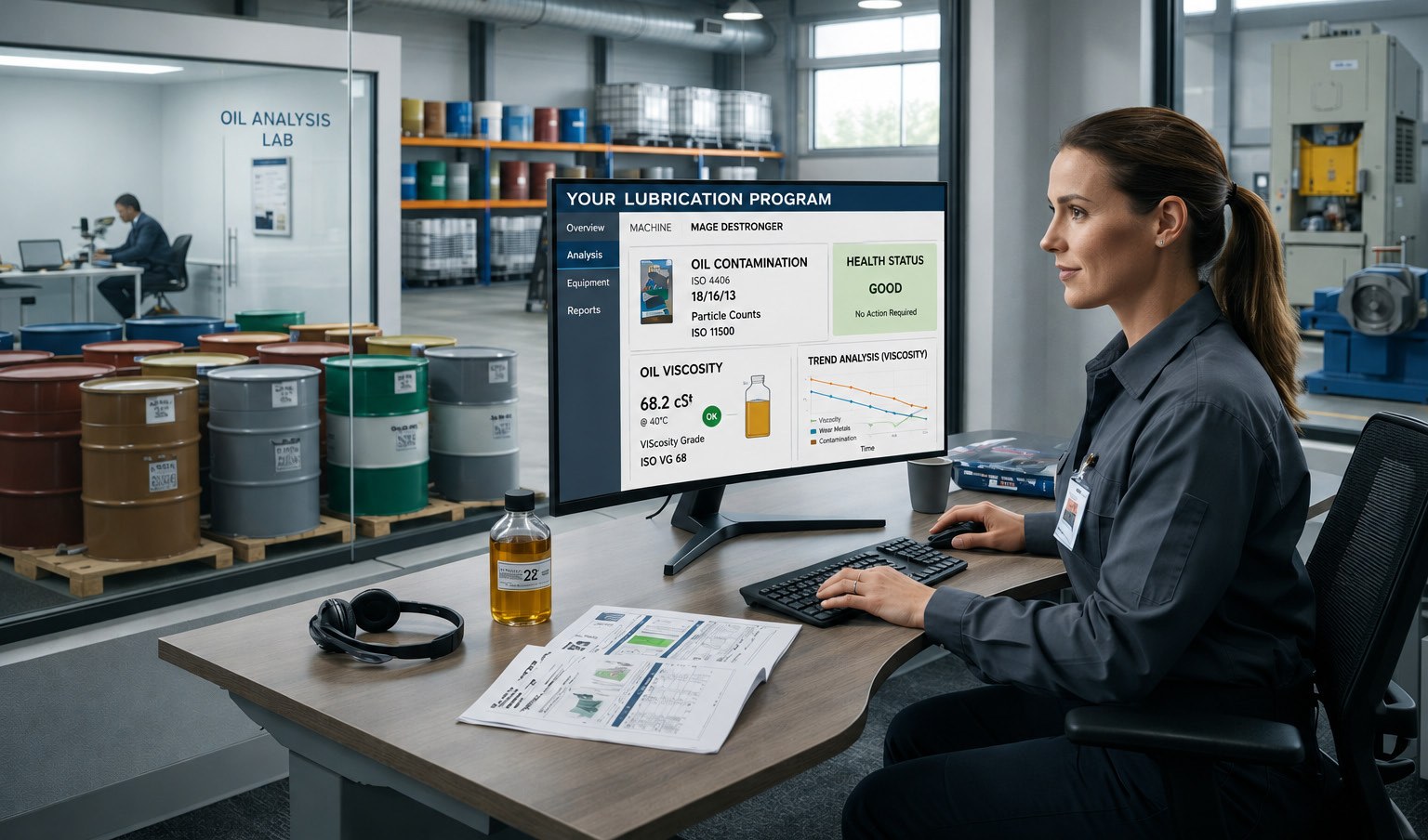
Let’s get one thing straight right away: treating lubricants like a generic commodity is the fastest way to wreck your equipment reliability. When you spend your days analyzing oil samples and interpreting SOS reports, you quickly understand that the lab report doesn’t lie. You can almost always spot the exact moment a purchasing department decided to save a few pennies per liter on a bulk order.
The right purchase decision isn’t just about filling a sump; it ensures equipment reliability, reduces downtime, and lays the foundation for an effective total lube management program. In heavy-duty environments, aligning your lubricant selection with OEM Recommendations and recognized technical standards is completely non-negotiable. Here is how to approach the purchasing phase strategically, rather than just shopping for the lowest bidder.
The OEM Baseline and Why It Matters
Before looking at price tags, you have to look at the manual. OEM specifications dictate the exact viscosity grades based on operating environment, performance categories, and approved product lists for a reason. Deviating from these doesn’t just risk catastrophic wear—it can instantly void your warranties.
However, OEM specs are just the starting point. You must cross-reference those requirements with independent technical standards. We are talking about the ASTM, DIN, and ISO benchmarks for viscosity, oxidation stability, and wear protection.
Never take a supplier’s marketing brochure at face value; cross-check their claims against independent test data and approvals.
Vetting the Supplier, Not Just the Oil
This is where many procurement strategies fall short. You aren’t just buying oil; you’re buying a partnership. Evaluate a supplier’s technical support capabilities before you sign a contract.
Do they have NABL-accredited labs? Do they support bringing in new technology and value-added services? A supplier’s supply chain reliability and local availability will save you much more money during a midnight breakdown than a slight discount on a drum of oil.
The True Cost of "Cheap" Oil
Ultimately, you have to perform a life-cycle cost analysis. The upfront price per liter is an illusion. You need to weigh the initial cost against extended drain intervals and reduced mechanical failures.
For example, upgrading to a premium synthetic oil might cost 30% more upfront, but if it doubles the service life in your hydraulic systems and keeps your SOS reports clean, it is the cheaper option by far.
What to Do Tomorrow
To stop buying on price and start buying on performance, implement these three steps this week:
- Draft a Spec Sheet: Create a rigid lubricant specification sheet for every piece of equipment on your floor.
- Build a Checklist: Develop a supplier evaluation checklist that heavily weights technical compliance, delivery reliability, and lab support.
- Document the “Why”: Use a decision matrix to compare your shortlists, and document exactly why a purchase decision was made. This creates a paper trail for audits and serves as an excellent training tool for new reliability engineers.
Building Your Technical Decision Matrix
When you are actually evaluating what fluid to buy, the professional reliability managers utilize Multi-Criteria Decision-Making (MCDM) frameworks to quantify qualitative assessments and standardize the selection process across diverse equipment fleets. The decision comes down to a few critical factors:
The base oil and its type: Do you actually need a premium synthetic, or will a high-quality mineral oil do the job? Which oil group is being used for blending?
The Additive Package: Look closely at the anti-wear and antioxidant agents, detergents, and dispersant’s. Are they suited for your specific machinery?
Physico-Chemical profiling: A technical decision matrix for lubricant procurement must be grounded in standardized testing data. These physico-chemical properties determine how the lubricant will survive the rigours of the operating environment. Viscosity is the most critical parameter, defining the fluid’s resistance to flow and its ability to maintain a load-bearing film. The Viscosity Index (VI) measures the rate of change of viscosity with temperature. Lubricants with a high VI, such as those formulated with synthetic base stocks or VI improves, maintain more consistent film thickness across the broad temperature ranges often encountered in heavy industry. Dropping Point (Grease): This is the temperature at which the grease transitions from a semi-solid to a liquid state, indicating the upper limit of its structural stability. Specialty Properties: Air Release, Foam, and Defensibility
The Reality of the Environment: A lubricant that performs perfectly in a climate controlled facility might fail in an environment plagued by temperature extremes, high dust, or constant moisture. The decision matrix must be tailored to the specific operating environment of the equipment.
Verify Material Compatibility: Establish mandatory checks for compatibility with seals, gaskets, and reservoir coatings to prevent systemic contamination and leaks. To select the best lubricant for your machinery, a Weighted Scoring Matrix is the most objective tool. It helps you balance technical requirements against commercial factors like cost and support.
Lubricant Selection Matrix Guide
A weighted matrix ensures that “cheap” options don’t win if they fail to meet critical technical standards, and “premium” options are justified by their performance.
1. Define Your Criteria and Weights
The total weight must equal 100%. You should prioritise criteria based on the equipment’s criticality. For high-stakes machinery, Technical Specifications and OEM Approval usually carry the most weight.
2. Scoring Scale
5 (Excellent): Fully exceeds requirements / OEM approved.
3 (Good): Meets all basic requirements.
1 (Poor): Barely meets minimum standards / No local support.
3. The Calculation
For every row, calculate the score as follows: Weighted Score = Raw Score X Weighting Percentage
Example: Industrial Gear-Oil Selection
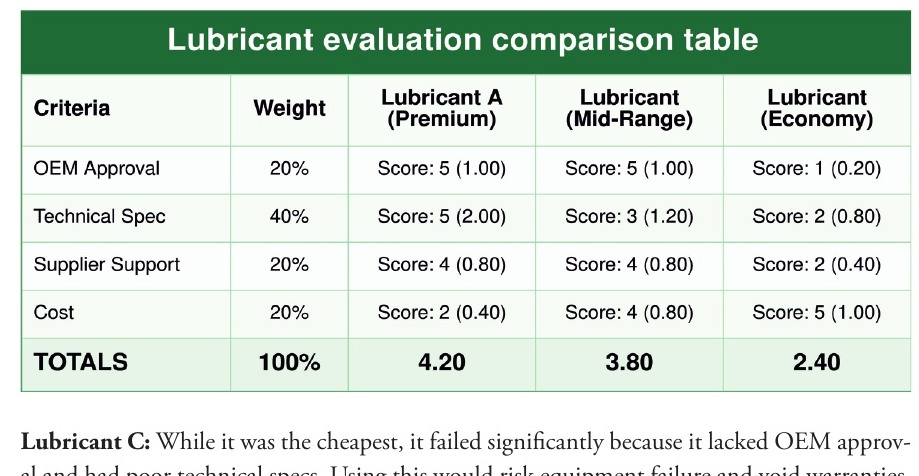
In this scenario, we are comparing three different gear oils for a critical plant gearbox.
Final Decision Analysis
The Winner: Lubricant A (Score: 4.20) Even though Lubricant A is the most expensive (scoring a low 2 in the cost category), it wins the matrix because it excels in Technical Specifications and carries the necessary OEM Approvals. Lubricant B: A solid contender, but its technical performance (Viscosity Index or Wear Protection) was only average compared to the premium option. Lubricant C: While it was the cheapest, it failed significantly because it lacked OEM approval and had poor technical specs.
Using this would risk equipment failure and void warranties. Getting the right lubricant on order is only half the battle. In Part 2, we’ll look at what happens when those drums and totes actually hit your loading dock.
We’ll step inside the lube room to cover inventory management, storage, and exactly how to keep your oil clean and dry before it ever enters a machine.
About the Author
Praveen Kumar is a seasoned professional with hands-on experience across automobile, wire, tyre, steel, cement, and heavy earthmoving machinery maintenance. He specialises in lubrication management, reliability engineering, and process optimization, helping teams translate complex technical concepts into practical field solutions. Passionate about precision and continuous improvement, Praveen develops SOPs, decision matrices, and visual training aids that drive measurable gains in equipment uptime and cost efficiency.
His cross-industry journey reflects a commitment to mentoring, innovation, and bridging the gap between theory and practice.
Keep reading