
Used Oil Re-Refining Engineering: Understanding Contamination, Degradation and Recovery Principles
Understand how oxidation, water, fuel, soot and wear metals degrade lubricants, and how engineered re-refining recovers useful hydrocarbon resources.
Abstract
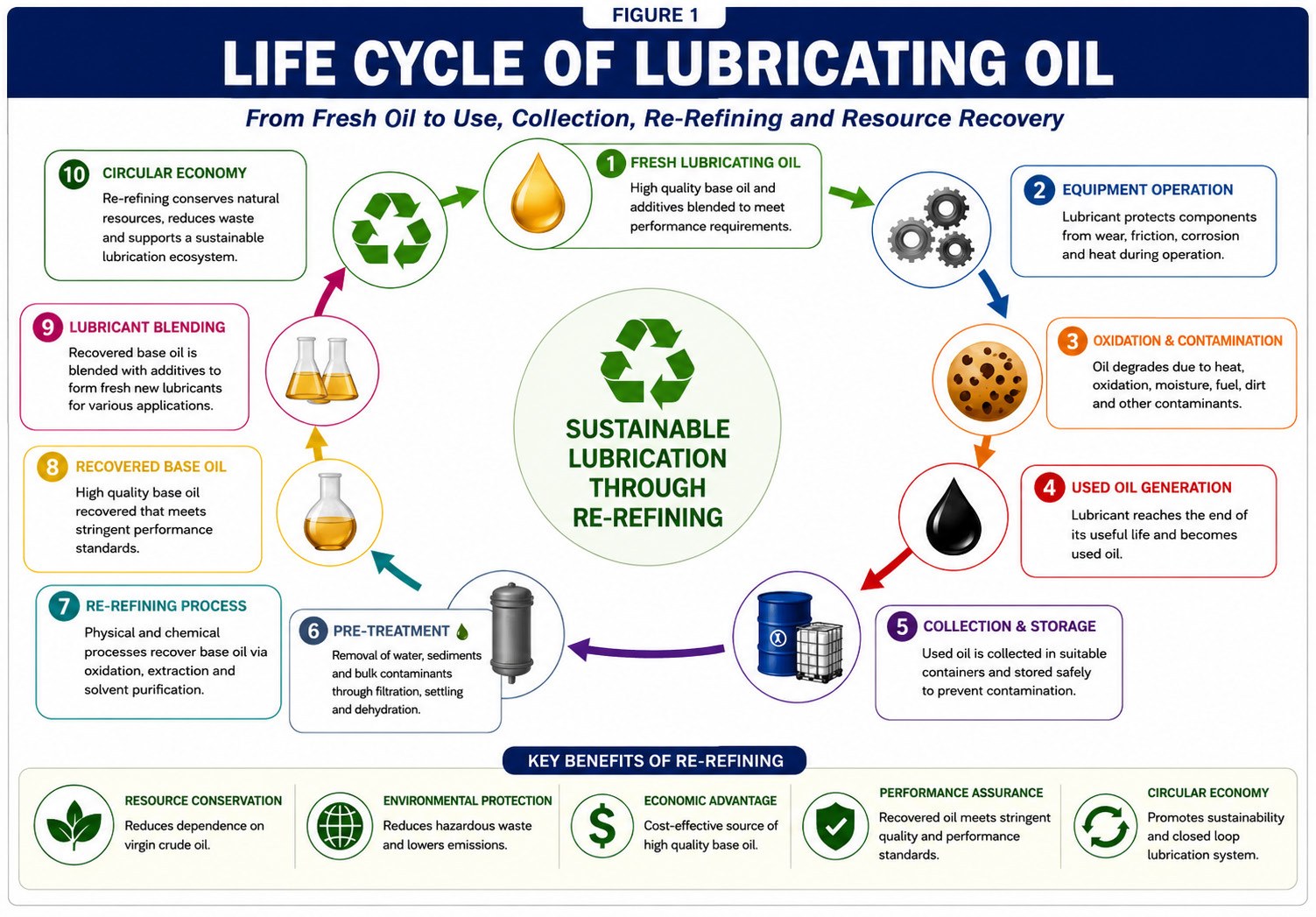
Lubricating oils play a critical role in protecting engines and industrial machinery from wear, friction, corrosion, and heat. During service, lubricants are exposed to oxidation, contamination, thermal stress, and additive depletion, resulting in a gradual decline in performance. Once the lubricant reaches the end of its useful service life, it becomes used oil.
Although used oil contains contaminants and degradation products, a significant portion of the original hydrocarbon base oil remains recoverable. This article explains the fundamental mechanisms responsible for lubricant degradation, including oxidation, water contamination, fuel dilution, soot loading, and wear metal generation. It also examines why used oil should be viewed as a valuable hydrocarbon resource rather than a waste material.
Furthermore, the article introduces the basic engineering principles behind re-refining, highlighting how contaminant removal and hydrocarbon recovery contribute to resource conservation, environmental protection, and sustainable lubricant management. Understanding these principles provides the foundation for modern used oil re-refining engineering and supports the transition toward a circular economy within the lubrication industry.
Introduction
Modern society depends heavily on lubricants for the reliable operation of engines, hydraulic systems, gearboxes, compressors, turbines, and industrial machinery. These lubricants reduce friction, minimize wear, control heat, and protect critical machine components under demanding operating conditions. However, lubricating oils are continuously exposed to high temperatures, oxygen, moisture, combustion by-products, and various contaminants during service.
Over time, these factors gradually alter the physical and chemical properties of the lubricant, resulting in performance degradation. Once the lubricant can no longer provide the required level of protection and performance, it is classified as used oil. A common misconception is that used oil is merely a waste product that must be discarded.
From an engineering perspective, this assumption is inaccurate. Although used oil contains contaminants, degradation products, and depleted additives, a significant portion of the original hy drocarbon base oil remains present and potentially recoverable. This understanding forms the foundation of modern used oil re-refining engineering.
By identifying degradation mechanisms and understanding the nature of contaminants, engineers can develop effective recovery processes that conserve resources, reduce environmental impact, and support sustainable lubricant management practices.
Understanding Used Oil
Used oil is any lubricating oil that has been used in service and has experienced physical or chemical changes that reduce its performance. Used oil can originate from engine oils, hydraulic oils, gear oils, compressor oils, turbine oils, and various industrial lubricants. During operation, lubricating oils are subjected to continuous exposure to heat, oxygen, mechanical stress, combustion gases, moisture, and external contaminants.
These conditions gradually alter the lubricant’s chemical composition and physical properties. As a result, the oil may experience increased acidity, viscosity changes, contamination buildup, and additive depletion. It is important to recognize that used oil is not simply “dirty oil.”
Rather, it is a complex mixture containing degraded lubricant molecules, contaminants, wear particles, oxidation products, and residual additives. The condition of used oil reflects both the health of the lubricant and the operating condition of the equipment in which it was used. Despite the presence of contaminants, a substantial portion of the hydrocarbon base oil remains intact.
This remaining hydrocarbon content represents a valuable resource that can potentially be recovered through appropriate re-refining processes. For this reason, modern engineering practices increasingly view used oil as a recoverable resource rather than a waste material.
Lubricant Degradation Mechanisms
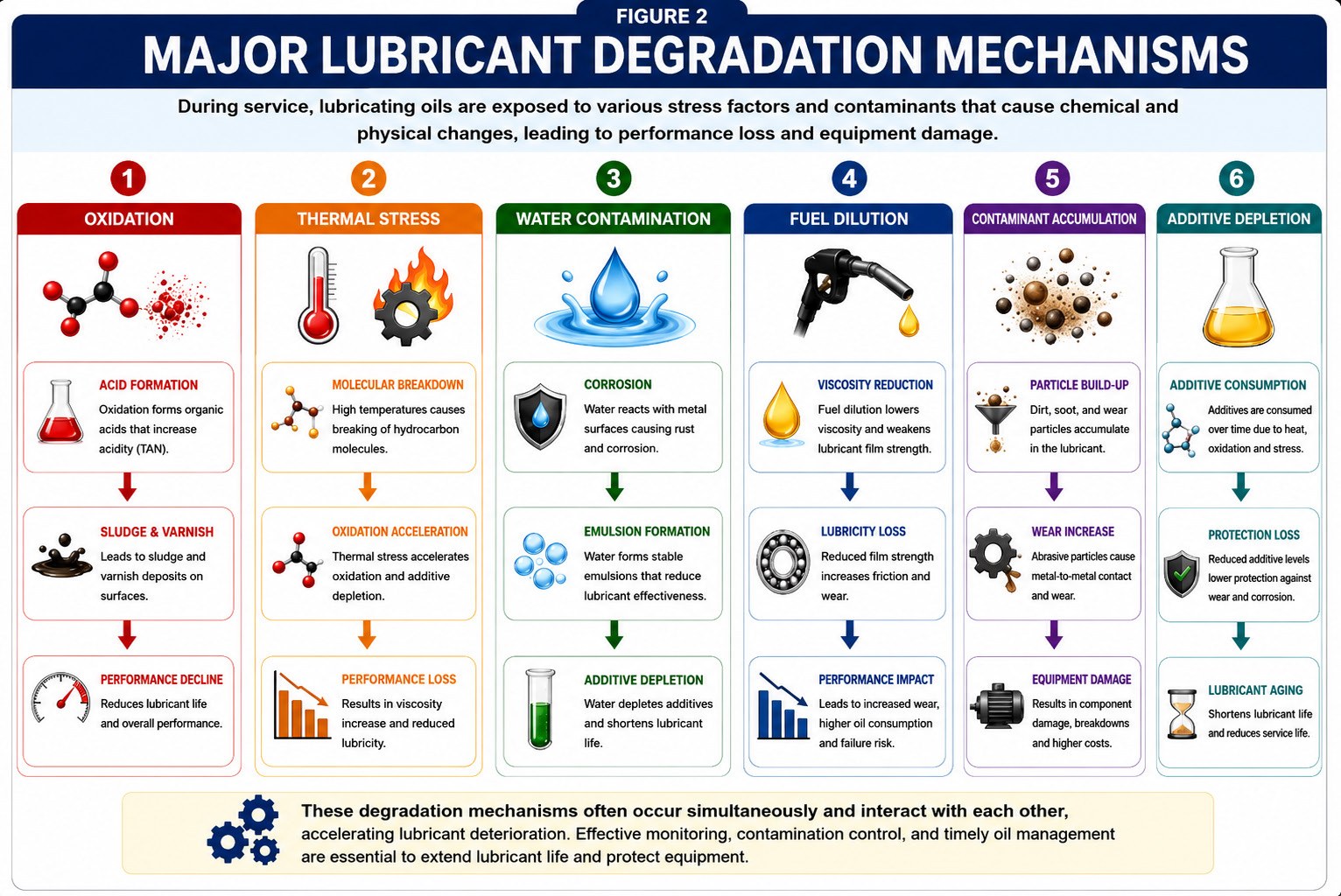
Lubricant degradation is a gradual process that occurs when lubricating oil is exposed to operating stresses over time. Understanding these degradation mechanisms is essential because they directly influence lubricant performance, equipment reliability, and the quality of used oil available for re-refining. One of the primary degradation mechanisms is oxidation.
When lubricating oil reacts with oxygen at elevated temperatures, oxidation products such as acids, varnish, and sludge begin to form. Oxidation increases oil acidity, reduces lubricant life, and can contribute to deposit formation within machinery. Thermal degradation is another important mechanism.
Excessive operating temperatures can break down hydrocarbon molecules, resulting in viscosity changes, reduced lubricant stability, and accelerated aging of the oil. Water contamination is a common problem in both industrial and automotive applications. Water may enter the lubricant through condensation, leaking heat exchangers, damaged seals, or improper storage practices.
The presence of water can promote corrosion, accelerate oxidation, reduce lubricating film strength, and contribute to emulsion formation. Fuel dilution is frequently observed in engine oils. Unburned fuel entering the crankcase can reduce viscosity, weaken the lubricant film, and negatively affect equipment protection.
In addition, lubricants continuously accumulate wear metals, dust, soot, and other contaminants during service. These contaminants not only degrade lubricant performance but also provide valuable information regarding machine condition and operating environment. The combined effect of oxidation, thermal stress, water contamination, fuel dilution, and contaminant accumulation ultimately determines the condition of used oil and influences the complexity of the re-refining process.
Major Contaminants in Used Oil
Major contaminants present in used oil significantly influence lubricant condition, equipment reliability, and the complexity of the re-refining process. Understanding these contaminants is essential for effective contaminant removal and hydrocarbon recovery. Water is one of the most common contaminants found in used oil.
It may enter through condensation, leaking cooling systems, damaged seals, or improper storage practices. Water contamination can accelerate oxidation, promote corrosion, and reduce lubricant performance. Wear metals are generated through normal equipment operation and component wear.
Common wear metals include iron, copper, aluminum, chromium, and lead. The concentration and type of wear metals often provide valuable information regarding machine condition and maintenance requirements. Dust and dirt contamination typically originate from the surrounding environment.
These solid particles can increase abrasive wear, reduce component life, and negatively affect lubricant cleanliness.
Fuel dilution is commonly encountered in engine oils. Excessive fuel contamination reduces viscosity and weakens the lubricant film, increasing the risk of wear and equipment damage. Soot is another significant contaminant, particularly in diesel engine oils.
Excessive soot loading can increase viscosity, promote deposit formation, and reduce lubricant effectiveness. Oxidation by-products, sludge, varnish precursors, and degraded additive residues also accumulate during service. These degradation products can adversely affect lubricant performance and complicate re-refining operations.
The identification and removal of these contaminants represent one of the primary objectives of modern used oil re-refining engineering.
Recovery Principles in Re-Refining
The primary objective of used oil re-refining is to recover valuable hydrocarbon resources while removing contaminants and degradation products accumulated during service. Successful re-refining depends on understanding the fundamental engineering principles that govern contaminant removal and base oil recovery. The first principle is dehydration.
Water is one of the most common contaminants in used oil and must be removed before further processing. Effective dehydration improves process efficiency and reduces the risk of equipment corrosion and operational problems. The second principle is solid contaminant removal.
Dust, dirt, wear particles, and sludge-forming materials must be separated from the oil. Mechanical filtration, settling, centrifugation, and other separation methods are commonly used to reduce the contaminant load. Another important principle is the removal of light hydrocarbons and volatile contaminants.
Fuel dilution and low-boiling compounds can negatively affect lubricant quality and must be separated during the recovery process. The recovery process also focuses on removing oxidation products, degraded additives, acidic compounds, and other unwanted materials that accumulate during lubricant service life. These contaminants can adversely affect the quality and performance of the recovered base oil.
Modern re-refining technologies are designed to maximize hydrocarbon recovery while minimizing thermal damage to the remaining oil. The effectiveness of any re-refining operation depends on its ability to balance contaminant removal, product quality, process efficiency, and environmental performance. Ultimately, re-refining is not simply a waste treatment activity.
It is a resource recovery process that transforms used oil into a valuable industrial feedstock suitable for further upgrading and lubricant manufacturing.
Engineering Perspective
The engineering significance of used oil extends far beyond waste management. Modern industries increasingly recognize used oil as a valuable secondary hydrocarbon resource that can contribute to sustainability, resource conservation, and circular economy objectives. From an engineering perspective, the quality of recovered oil depends on several critical factors, including feedstock quality, contamination levels, collection practices, processing technology, and laboratory verification.
Poor collection and storage practices can significantly reduce recovery efficiency and increase processing complexity. The success of any re-refining program begins with responsible collection, proper segregation, contamination control, and traceability throughout the supply chain. These factors directly influence product quality, recovery yield, and overall process economics.
Advancements in processing technologies, analytical testing, and quality control systems have significantly improved the performance and acceptance of re-refined base oils. Today, engineering decisions are increasingly based on measurable performance parameters rather than assumptions regarding feedstock origin. As industries continue to pursue sustainability targets and resource efficiency improvements, used oil re-refining is expected to play an increasingly important role in the future of lubricant life cycle management.
Practical Used-Oil Analysis Example
Used oil analysis is one of the most effective tools for evaluating lubricant condition, machine health, and re-refining suitability. By examining key physical and chemical parameters, engineers can identify degradation mechanisms, contamination sources, and the remaining value of the lubricant. Table 1 presents a simplified example of condition changes observed during lubricant service.
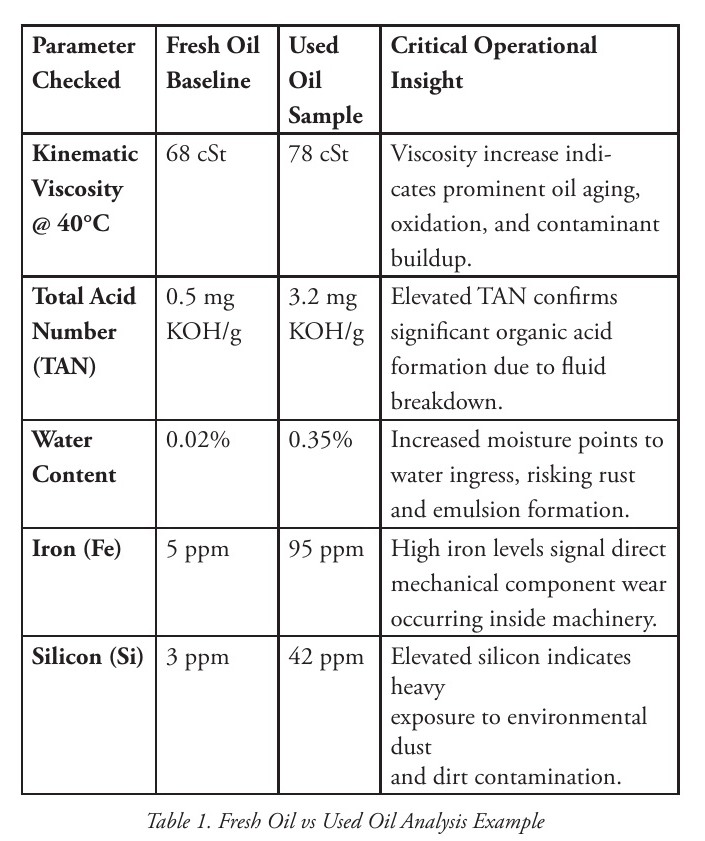
From a re-refining perspective, such analysis helps determine suitable recovery methods and provides valuable information regarding contaminant removal requirements before base oil recovery. Oil analysis therefore serves as an important bridge between lubricant condition monitoring and successful re-refining operations. This engineering approach demonstrates that used oil is not merely a waste stream but a measurable and manageable resource whose condition can be scientifically evaluated before recovery and re-use.
Conclusion
Used oil is the result of lubricant degradation caused by oxidation, thermal stress, contamination, and additive depletion during service. Although these processes reduce lubricant performance, they do not eliminate the value of the underlying hydrocarbon resource. Understanding the mechanisms of lubricant degradation and the nature of contaminants is essential for developing effective re-refining strategies.
Through appropriate contaminant removal and recovery processes, a significant portion of the original hydrocarbon content can be preserved and returned to productive use. Modern used oil re-refining engineering supports resource conservation, environmental protection, waste reduction, and sustainable industrial development. As industries increasingly adopt circular economy principles, re-refining will continue to serve as an important bridge between lubricant use and resource recovery.
The future of sustainable lubrication depends not only on producing high performance lubricants but also on managing used lubricants responsibly and recovering valuable resources through scientifically engineered re-refining processes.
References
- ASTM D445 – Kinematic Viscosity Test Method
- ASTM D664 – Standard Test Method
- ASTM D6304 – Standard Test Method
- ASTM D5185 – Standard Test Method
- API Base Oil Interchangeability Guidelines.
- Machinery Lubrication Magazine Technical Publications on Lubricant Reliability and Condition Monitoring.
- Noria Corporation Technical Resources on Used Oil Analysis and Re-Refining Engineering.
- Industry Best Practices for Used Oil Collection, Contamination Control, Resource Recovery and Sustainable Lubricant Management.
About the Author
Prem Raj is an Industrial Lubrication Consultant with over 30 years of practical experience in lubricants, grease manufacturing, oil analysis, and used oil re-refining. He has worked extensively in automotive and industrial lubrication applications and actively promotes sustainable lubrication practices, resource recovery, and technical knowledge sharing. His areas of interest include lubricant reliability, contamination control, condition monitoring, and circular economy approaches in the lubrication industry.
Keep reading