Why Clean Sample Bottles Are Key to Reliable Oil Analysis
Discover why the cleanliness of your sampling equipment is the foundation of accurate and reliable oil analysis results.
In high-stakes industries like Steel, Cement, and Power, the accuracy of a fluid sample depends entirely on the bottle that holds it. Even when the oil inside a machine is clean, dirt introduced during sampling or storage can ruin laboratory results. This leads to “false readings” that trigger expensive, unnecessary maintenance or, worse, hide a real system failure. To stop this, the industry uses the ISO 3722 test method to measure how many particles a container adds to a sample.
ISO 3722: The Method, Not the Metric
The 5-Minute Sampling Checklist
- Purge the Port: Flush 10x the dead-space volume before collecting.
- Down-facing Cap: Hold the cap facing down to avoid airborne dust.
- The 80% Rule: Fill to 80% to allow lab agitation; seal immediately.
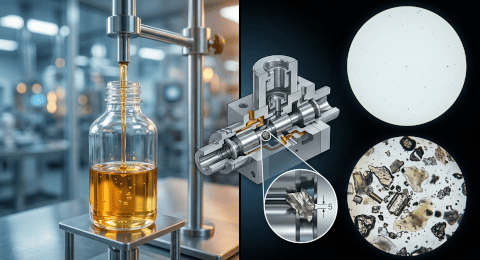
A common misconception is that ISO 3722 provides a “pass/fail” grade. In reality, the standard only defines how to extract and measure the particles. It involves rinsing the container with a clean fluid and counting the debris released.
Because the standard does not set specific limits, each plant must decide what is “clean enough” based on how sensitive their machines are.
Defining Your Cleanliness Tiers
To keep things simple on the shop floor, many organizations use three main categories based on the number of particles found (specifically at the > 10 μm size):
| Classification | Particle Limit (≥ 10 μm) | Typical Industry Application |
|---|---|---|
| Clean | ≤ 100 particles/ml | Gearboxes, Coal Mills, Conveyor Drives |
| Super Clean | ≤ 10 particles/ml | Steam Turbine Control Oil, General Hydraulics |
| Ultra Clean | ≤ 1 particle/ml | Steel Mill Servo-Valves, High-Pressure Systems |
The Danger of “Microscopic Silt” (Sub-10 μm)
While particles larger than 10 μm cause immediate abrasive wear, modern precision systems are increasingly threatened by “silt” in the 4–6 μm range. In servo-controlled systems with microscopic clearances, these fine particles interfere with spool movement and degrade control accuracy.
A container may technically meet “Clean” limits at > 10 μm but still harbor enough 4 μm particles to compromise a sensitive system. Consequently, reliability leaders are shifting monitoring to lower thresholds like > 4 μm and > 6 μm.
Beyond the Bottle: Sampling Discipline
Achieving “Ultra Clean” results requires more than just buying the right hardware. Even the cleanest container cannot compensate for poor sampling discipline:
- Keep it Sealed: Do not open the bottle until the exact second you are ready to take the sample.
- Watch the Dust: Never leave caps open or place them on dirty surfaces in the plant.
- Flush the Line: Always flush the sampling port thoroughly before collecting the oil to ensure you are testing the actual system fluid.
Summary
By combining the standardized extraction methods of ISO 3722 with strict internal limits and disciplined handling, organizations can protect the integrity of their oil analysis programs. In the race for reliability, ensuring your sample bottle is as clean as your system is not just best practice—it is a technical necessity.
Keep reading