
Optimizing Wire Rope Lubrication and Reliability
Choose penetrating and coating lubricants, improve field application and protect wire ropes from internal wear and corrosion.
Wire ropes serve as critical load-bearing components across industrial machinery and structural installations. A standard wire rope consists of continuous wire strands wrapped helically around a central core. Most designs feature high-carbon steel wires formed into strands. Core materials vary based on application requirements, utilizing steel, synthetic polymers, or natural fibers.
Industry standards categorize wire ropes by specific parameters:
- Overall rope diameter
- Steel grade
- Preforming process
- Lay pattern
- Number of strands
- Number of individual wires per strand
A standard designator such as 6x36 specifies a rope constructed from six strands, with each strand containing 36 individual wires. Varying strand arrangements balances flexibility against resistance to abrasion and crushing. Smaller wires provide higher flexibility for sharp bending over small sheaves. Larger outer wires offer superior resistance to dragging, dirt contact, and mechanical abrasion.
Core Constructions and Classifications
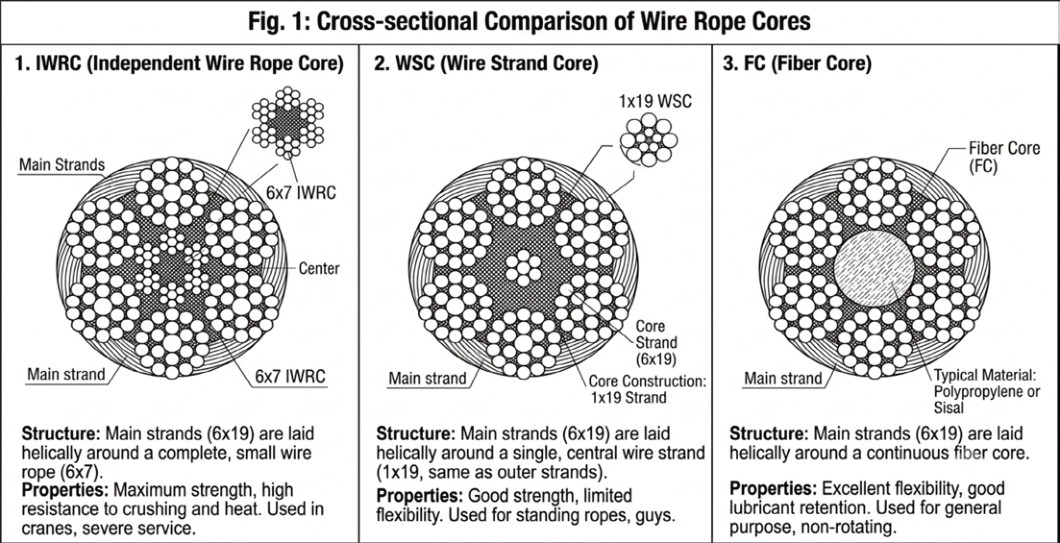
The central core supports the outer strands under tension. Core designs fall into three primary categories:
- Independent Wire Rope Core (IWRC): Features a 6x7 wire rope wrapped around a 1x7 strand core, creating a 7x7 structural configuration. IWRC designs deliver high breaking strength and superior crushing resistance. Internal field lubrication remains challenging due to the dense steel construction.
- Wire Strand Core (WSC): Uses a single wire strand as the core. WSC configurations provide high tensile strength for static or standing rope applications. Field relubrication requires specific application techniques to ensure adequate penetration.
- Fiber Core (FC): Historically manufactured from sisal, modern fiber cores often utilize synthetic polymers. Fiber cores yield lower tensile strength than steel cores but offer high flexibility for overhead crane applications. Natural fiber cores absorb liquid lubricants, acting as an internal reservoir.
Lay Patterns and Strand Orientations
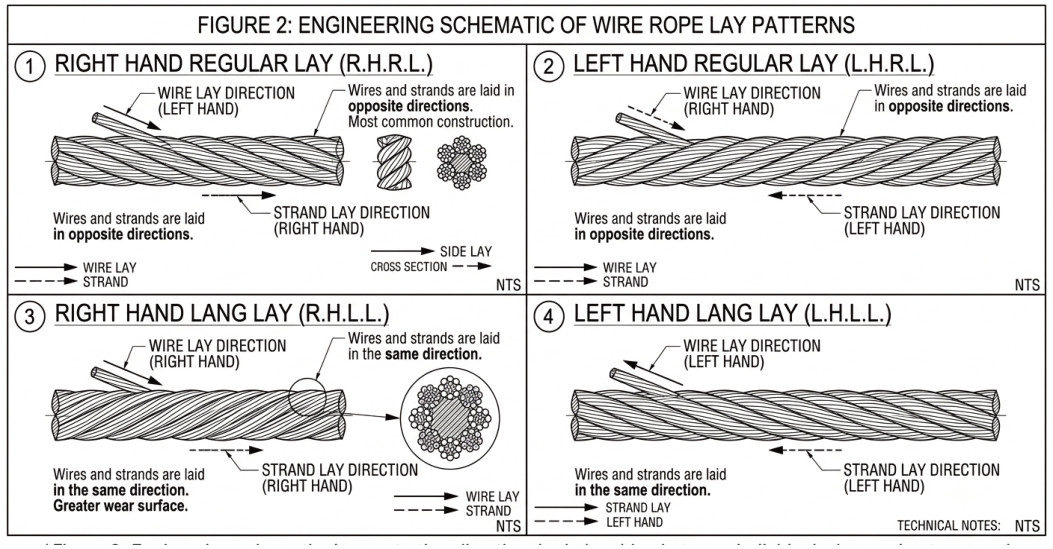
The lay indicates the direction strands and wires twist during fabrication. Four primary lay configurations exist:
- Right Lay: Strands twist to the right moving away from the observer.
- Left Lay: Strands twist to the left moving away from the observer.
- Regular Lay: Wires in the strand twist opposite to the direction of the strands.
- Lang Lay: Wires in the strand twist in the same direction as the strands. Lang lay ropes provide enhanced fatigue resistance due to greater surface wire exposure.
High-carbon steel provides strength, resilience, and cost-effectiveness. Ropes are supplied uncoated or galvanized. Non-preformed ropes present safety hazards: if outer wires break or cut, they straighten and protrude as sharp burrs. Preformed ropes hold shaped strands naturally in position, preventing wires from popping out, enhancing fatigue resistance, and improving performance over small sheaves and sharp angles.
Functions and Selection of Wire Rope Lubricants
Wire rope lubricants must fulfill three core functions:
- Reduce internal friction as individual wires slide over each other during operation.
- Provide corrosion protection and lubrication within the core and internal wires.
- Protect exterior surfaces from ambient corrosion and environmental wear.
Operating environments introduce rain, salt spray, high or low ambient temperatures, acids, strong bases, sulfur, salt brines, fumes, gases, humidity, and abrasive contaminants. Internal damage results from lubricant depletion, degradation by-products, moisture absorption, and fretting corrosion caused by relative movement between contacting wires.
Penetrating vs. Coating Lubricants
Most wire ropes fail from the inside out, making penetrating lubricants vital:
- Penetrating Lubricants: Formulated with a petroleum solvent carrying protective fluid deep into the core. As the solvent evaporates, a heavy lubricating oil remains to protect internal strands. Fluid oil formulations also perform a critical “washing” action, flushing away external abrasive dirt and contaminants.
- Coating Lubricants: Penetrate slightly while sealing the exterior surface against moisture and ambient elements, reducing surface wear and fretting.
A dual-application strategy provides maximum protection: saturation with a penetrating fluid to saturate the core, followed by a coating lubricant to seal and protect the external surface.
| Lubricant Type | Primary Characteristics | Key Considerations |
|---|---|---|
| Petrolatum | Excellent water and corrosion resistance; translucent film allows visual inspection. | May drip at elevated temperatures; resists cracking in cold conditions. |
| Asphaltic | High adhesion for long-term storage. | Dries to a dark, hard surface that hinders inspection; cracks and becomes brittle in cold climates. |
| Grease | Formulated with sodium, lithium, lithium-complex, or aluminum-complex soap thickeners. | Soft semi-fluid consistency; requires pressure lubricators for partial penetration. |
| Petroleum / Vegetable Oils | Superior penetration; washes away surface contaminants; easily applied. | Transparent film aids routine inspection; additive design ensures wear/corrosion protection. |
Manufacturing and Field Relubrication Practices
Manufacturers apply primary lubricants during wire formation. For fiber cores, fluid application ensures full core absorption to serve as a continuous lubricant reservoir. Steel cores receive lubricant streams immediately before passing through the closing die that twists wires into strands, ensuring total wire coverage.
Mechanical loading, bending, and stretching deplete factory lubricants over time. Unlubricated fiber cores dry out under operating heat; once dry, they absorb atmospheric moisture, accelerating internal corrosion.
Field Application Procedures
Dirty ropes require surface cleaning prior to relubrication. Remove accumulated layers of hardened lubricant, dirt, and contaminants using wire brushes, petroleum solvents, compressed air, or steam cleaners. Dry the cleaned ropes immediately to prevent surface flash rusting.
Apply field relubricants using spray, brush, dip, drip, or pressure-boot methods:
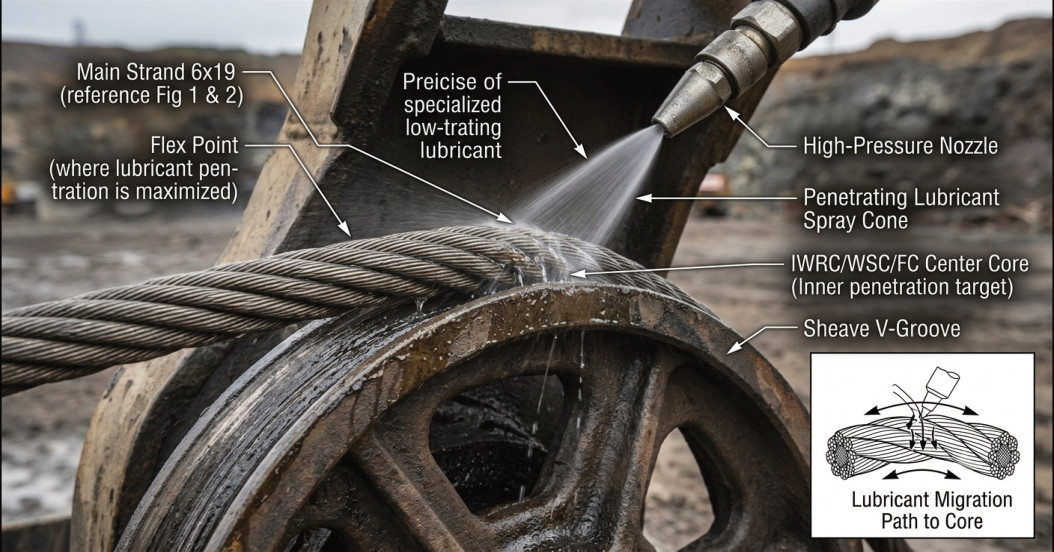
- Sheave/Drum Application: Penetrating lubricants are best applied where the rope passes over a sheave or drum. Bending causes outer strands to separate slightly, allowing fluid lubricant to reach the core.
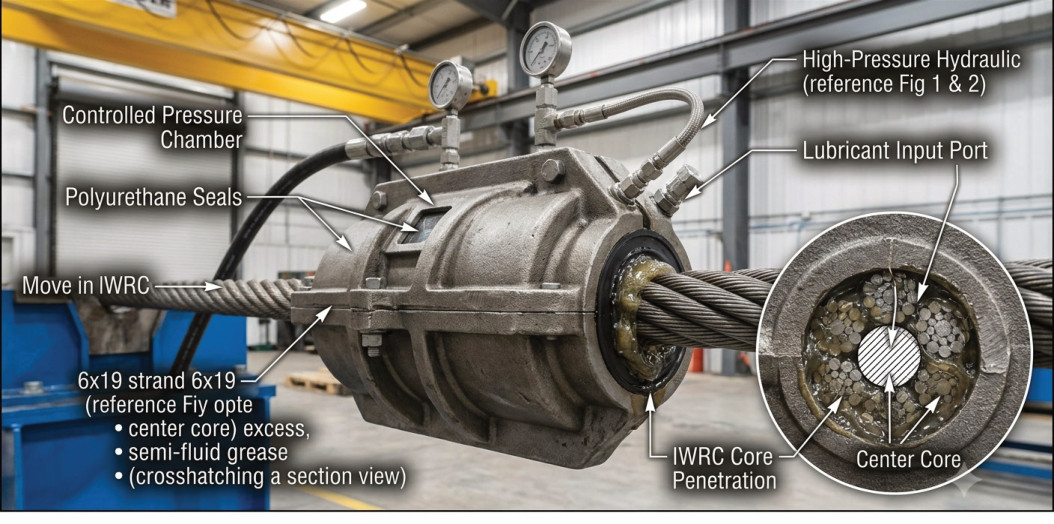
- Pressure Boot Application: Pressure boots effectively inject grease along straight, pulled sections of rope.
Avoid excessive lubricant application to prevent workplace safety hazards.
Preventing Operational Abuse and Premature Failure
Wire rope fatigue life is cumulative and shortened by mechanical abuse and environmental factors:
- Mechanical Abuses: Worn-out sheaves, poor winding practices, improper splicing, and inadequate storage conditions.
- Shock Loading: High stress loads from jerking, rapid acceleration, or sudden deceleration degrade rope fatigue life.
- Corrosive & Abrasive Wear: Internal wire friction and external drag-rope abrasion reduce rope diameter, leading to core failure and internal wire breakage. Pitting acts as stress risers that trigger premature failure.
Equipment scheduled for extended shutdown requires rope removal, thorough cleaning, lubrication, and controlled storage.
Performance Standards and Field Case Studies
Selecting high-performance lubricants requires evaluating published technical data sheets against standardized testing protocols. Key evaluation benchmarks include:
- Wear Protection (ASTM D-2783 / Four-Ball EP): Target a Weld Point exceeding 350 kg and a Load Wear Index exceeding 50.
- Corrosion Resistance (ASTM B-117 / Salt Spray): Target performance exceeding 60 hours.
- Moisture Protection (ASTM D-1748 / Humidity Cabinet): Target performance exceeding 60 days.
Operational Results & Field Data
Lubrication engineering field experience demonstrates that penetrating lubricants—used alone or alongside coating lubricants—typically double wire rope operational life by displacing water and contaminants while replacing them with protective oil films:
- Gold Mining Operations:
- At one mine, four 44 mm ropes extended their average service life from 18.5 months to 43 months.
- At another mine, four 43 mm x 2073 m ropes extended service life from an average of 8 months to 12 months.
- Manufacturing Facilities:
- Overhead cranes (5-ton to 10-ton capacity) utilizing 3/8-inch and 5/8-inch diameter ropes saw operational life more than double.
Proper field relubrication turns potential downtime, labor, and capital hardware replacement costs into significant operational savings.
About the Author

Chander Mohan Sharma (C M Sharma) brings over three decades of hands-on experience in industrial lubrication. A former Senior Manager at Tata Steel, he superannuated after a distinguished career overseeing lubrication across project planning and plant operations. His expertise spans critical equipment in the Steel, Power, Mining, and Cement industries. Today, he continues to share his knowledge through consulting and training assignments across India, helping industries strengthen their lubrication and reliability practices.
Keep reading