
Three Industries, Three Failure Modes: What Oil Analysis Revealed Before the Machines Failed
Marine, mining and wind-power cases show how oil analysis becomes effective maintenance action.
Practical case studies from Marine, Mining, and Wind Power show why Condition Monitoring succeeds only when test data connects directly to machine design, operating context, and a disciplined response.
A lubricant sample test report delivers a message from inside a machine. However, this message rarely arrives in plain language. A change in viscosity may reflect oxidation, fuel dilution, contamination, or topping off with the wrong product. A rise in iron levels may indicate active wear, harmless break-in, or simply improper sampling from the wrong location. Therefore, the laboratory result is not the diagnosis; it forms one part of an evidence chain.
After two decades in lubrication analysis, I have observed that successful condition-monitoring programs share three habits. They establish a repeatable baseline, combine complementary tests, and convert every significant alarm into a specific maintenance action. The following anonymized cases illustrate this approach across three distinct operating environments. Although client identities and non-essential operating details remain confidential, the technical patterns and diagnostic logic accurately reflect field conditions.
CASE STUDY 1 | MARINE A Viscosity Drop That Was Not an Oil Problem
Operating Concern
A medium-speed auxiliary diesel engine on an ocean-going vessel showed a steady drop in crankcase oil viscosity over three monthly samples. The crew initially suspected that someone added a lower-viscosity top-up oil. Wear-metal levels remained moderate, oil pressure stayed within acceptable limits, and no obvious leak was visible. Because the vessel operated normally, site personnel nearly treated the trend as a housekeeping issue rather than an emerging reliability risk.
Evidence
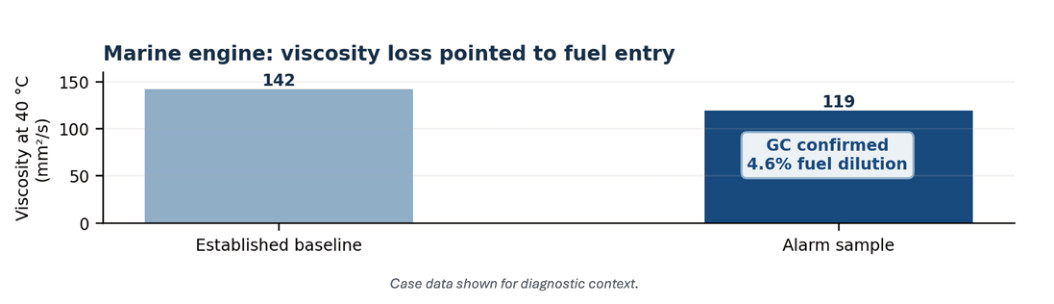
Viscosity at 40 °C dropped from 142 to 119 mm²/s, while the flash point decreased and FTIR showed only a modest oxidation rise. Water content measured by Karl Fischer remained low. That combination proved critical: severe oxidation normally drives viscosity upward, not downward. Gas chromatography (GC) fuel-dilution analysis confirmed approximately 4.6% distillate fuel in the lubricant. Low wear-metal results did not clear the engine; fuel dilution reduced film strength before substantial secondary wear developed.
Root Cause and Action
The pattern pointed away from oil degradation and toward fuel entry. Inspection revealed poor injector spray quality on one cylinder and incomplete combustion during prolonged low-load operation. Technicians overhauled the defective injector, reviewed operating practices, and changed the oil because dilution exceeded the vessel’s action limit. A short-interval sample after 60 running hours confirmed that fuel dilution stopped increasing, and subsequent samples established a stable viscosity baseline.
Reliability Lesson
Single-test interpretation leads to misdiagnosis. Viscosity identified the symptom, flash point and FTIR narrowed the root causes, and GC quantified the contaminant. The sample detected a combustion-system fault before bearing distress occurred. For marine engines, an effective testing panel must connect lubricant condition with engine health: track viscosity, water, base number, oxidation/ nitration, wear metals, and fuel dilution against engine hours, load patterns, and oil additions.
CASE STUDY 2 | MINING Why New Hydraulic Oil Kept Becoming Dirty
Operating Concern
A large hydraulic excavator at an open-cast mine suffered repeated servo-valve sticking and premature pump failures. Maintenance replaced reservoir oil frequently, yet the problem returned within weeks. Personnel regarded the dusty environment as unavoidable and focused on purchasing cleaner oil. However, the core issue was not dirt presence, but how dirt entered and why the system failed to remove it.
Evidence
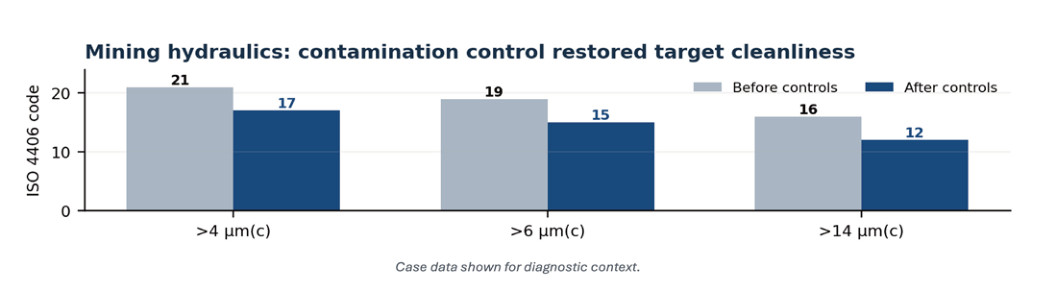
Particle counting repeatedly returned ISO 4406 cleanliness codes around 21/19/16, exceeding the target of 17/15/12 for sensitive hydraulic circuits. Elemental analysis showed elevated silicon levels, but silicon alone can originate from sealants or additive chemistry. Patch microscopy resolved the ambiguity: sharp, angular mineral particles dominated the debris, accompanied by fresh ferrous sliding-wear particles. Filter-debris examination showed rapid return-element loading, while samples taken immediately after oil changes improved only briefly.
Root Cause and Action
A contamination-control audit revealed three linked defects: a damaged reservoir breather, poor sealing at a frequently opened inspection cover, and oil transfer through unfiltered containers. The site installed a high-efficiency desiccant breather, corrected the cover seal, introduced dedicated sealed transfer equipment with kidney-loop filtration, and mandated cleanliness verification for incoming oil batches. Technicians also relocated sampling ports to live turbulent zones so results represented circulating oil rather than settled reservoir debris.
Reliability Lesson
Within two filtration cycles, cleanliness improved to 17/15/12 and remained controlled. Furthermore, valve sticking declined and ferrous debris generation slowed down. This case demonstrates why an oil change is not a contamination-control strategy: if ingress paths remain open, clean oil rapidly becomes dirty oil. Mining programs must trend particle counts, water, viscosity, elemental data, and filter debris together, tying alarm limits to component sensitivity rather than a single site-wide metric.
CASE STUDY 3 | WIND POWER When Moisture Turned Gearbox Oil into a Wear Risk
Operating Concern
A wind turbine in a humid coastal location showed recurring water alarms in its gearbox oil. Operators initially attributed the readings to seasonal condensation because the oil appeared clear, gearbox temperatures remained normal, and elemental wear metals stayed below OEM limits. Over successive samples, water levels continued to rise, accompanied by a slight increase in high-speed-shaft bearing vibration.
Evidence
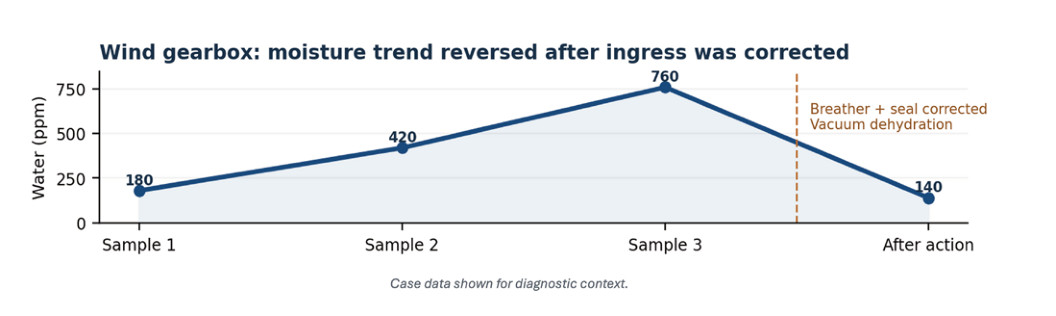
Karl Fischer water content increased from 180 ppm to 420 ppm, eventually exceeding 750 ppm across three sampling rounds. Concurrently, the acid number rose, and membrane patch examination revealed darkening from oil degradation products. Particle counts and ferrous-density results increased, although ICP iron levels appeared only moderately elevated. Together, the data showed that moisture had escalated beyond a minor oil-quality issue to actively degrade lubrication and generate wear.
Root Cause and Action
Inspection revealed a saturated gearbox breather and a damaged seal that allowed humid air to enter. Repeated heating during operation and cooling during shutdown caused moisture to condense inside the gearbox. Technicians treated the oil with offline vacuum dehydration, replaced the breather and seal, and inspected the high-speed bearing during a planned maintenance window. Follow-up sampling occurred at shorter intervals until water levels dropped below 150 ppm and wear trends stabilized.
Reliability Lesson
Water contamination does not need to turn oil cloudy before causing damage. Dissolved water weakens lubricating films, promotes corrosion, accelerates oxidation, and reduces bearing fatigue life. The trend provided the vital warning: rising water, increasing acidity, higher ferrous debris, and matching vibration changes. For wind turbines, routine moisture testing must pair with effective breathers, regular seal inspections, and follow-up sampling after corrective actions.
From Test Result to Maintenance Decision
These cases differ in equipment type, speed, load, and lubricant selection, yet the diagnostic discipline remains identical. First, draw a representative sample from a consistent point under normal operating conditions. Second, run complementary tests to evaluate three core areas: lubricant health, contamination, and machine wear. Third, evaluate results against historical data and operating context rather than relying solely on generic limits. Finally, close the loop by documenting the inspection, corrective action, and follow-up sampling.
Predictive maintenance does not begin with running more tests; it begins with asking better questions. Is the lubricant degrading, is an external contaminant entering the system, or is the machine generating abnormal wear? When you design a testing strategy around those questions, oil analysis transforms from simple pass/fail reporting into a reliable early-warning system that drives proactive maintenance.
About the Author

Mickey Kapadia, Founder of the Atlas Group, brings over 30 years of experience in the testing and inspection industry, with deep expertise in the Fuel and Lubricants sector. Over the past 14 years, he has built the Atlas Group into a portfolio of specialised businesses covering testing, inspection, quality and compliance. His technical knowledge and hands-on industry experience have been central to establishing Atlaspec Labs as a full-fledged NABL-accredited ISO/IEC 17025 testing laboratory and a trusted partner to clients worldwide.
Keep reading